
June 12, SpaceX NASDAQ Listing! 4 Indirect Investment Strategies for Retail Investors
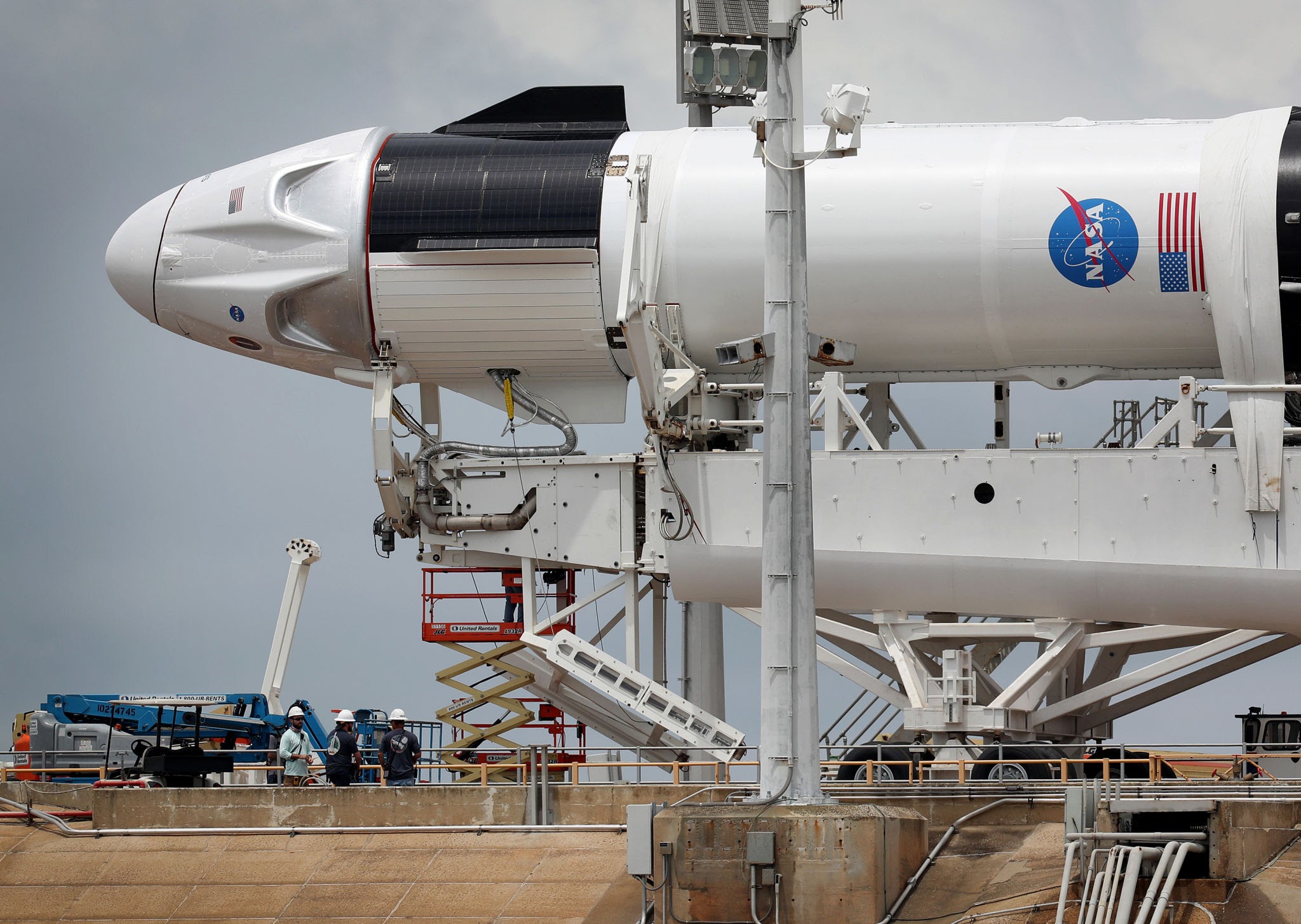
Joe Raedle / Getty Images
1. 5 Times the Size of Samsung Electronics, the Largest Market in History Opens
'SpaceX,' the space enterprise led by Elon Musk, is finally entering the institutional stock market. Moving beyond the mere listing of a large corporation, Wall Street is already pouring out evaluations that "the space industry is the next runner after AI."
Listing Date and Ticker: On June 12, 2026, it will be listed on the NASDAQ market under the ticker symbol 'SPCX.'
Unprecedented Corporate Value: The corporate value reaches 1.75 trillion dollars (approximately 2,578 trillion KRW). This size is more than 5 times the market capitalization of Samsung Electronics, an amount that shatters the previous all-time largest IPO (Initial Public Offering) record set by Saudi Aramco in 2019.
Solid Fundamentals: The number of subscribers for 'Starlink,' the satellite internet service, has already surpassed 9 million. It is a company generating actual revenue (estimated 2026 revenue of 15 billion to 16 billion dollars) rather than just simple expectations.
2. "Retail Investors Cannot Directly Subscribe" What is the Real Reason?
While many investors are anticipating the public offering subscription, unfortunately, it is practically close to impossible for ordinary retail investors to be directly allocated underlying shares of SpaceX.
Limitations of the US IPO System: Unlike South Korea, the United States does not have regulations that mandatorily allocate public offering shares to retail investors. Lead underwriters allocate the volume first to long-term investment institutions, such as pension funds or asset management companies.
High Domestic Entry Barrier: Mirae Asset Securities is participating as one of the global lead underwriters to bring a volume of about 1 billion dollars (approximately 1.5 trillion KRW) into the domestic market, but the minimum required participation amount is known to be 1.5 billion KRW, making small-scale investment difficult.
Prohibition on Pre-IPO Purchases: There is also a method to directly buy unlisted shares before the listing, but it is not recommended due to risks such as excessive fees reaching about 10% and selling restrictions.
3. 4 Indirect Routes to Invest in SpaceX from South Korea
Although direct subscription is difficult, a clear path exists to invest indirectly through domestic stock and overseas stock accounts.
① Direct Purchase of US-Listed ETFs (XOVR, NASA)
The XOVR ETF directly holds underlying shares of SpaceX, making it the most intuitive alternative.
The NASA ETF fills about 10–11% of its total assets with SpaceX. However, because a 'Lock-up' is imposed for 6 months after the listing—restricting selling identically to insider shareholders—the initial stock price rise may not be immediately reflected.
② Utilization of US IPO-Themed ETFs (FPX, IPO)
This is a structure that incorporates new stocks into the portfolio immediately after listing.
FPX is highly likely to incorporate SpaceX within about 6 trading days after listing, and the IPO ETF tends to incorporate it within 7 to 14 days in the case of large-scale stocks, making them suitable for investors targeting short-term profits in the early stages of listing.
③ Purchase of Domestically Listed Aerospace ETFs (Most Recommended)
Currency exchange is not required, and one can enjoy tax-free and separate taxation benefits by utilizing an ISA (Individual Savings Account) or a pension account, making it the safest and most comfortable method.
Major products include HANARO US Aerospace & Tech, KODEX US Aerospace, and TIGER US Space Tech. Domestic ETFs cannot hold unlisted shares, so it is currently a form of indirect investment; however, they are designed to automatically incorporate SpaceX at a maximum weight of 25% within 2 to 3 days once it is listed.
④ Purchase of Listed Companies Holding Shares (Google, Tesla)
This is a method of buying shares of Google (Alphabet) and Tesla, which already hold large stakes in SpaceX. However, since the stock prices of those companies have already risen significantly, it is safer to approach with a long-term installment (dollar-cost averaging) method rather than putting in a large lump sum at once.
4. SpaceX '3 Major Prohibitions' and Strategies to Protect Your Retirement Funds
The space industry has infinite growth potential, but its volatility is just as large. Experts advise that a calm and objective strategy, without getting swept away by the market mood, is necessary.
Prohibition on All-In (Bulk) Buying on the First Day of Listing: This public offering price (1.75 trillion dollar valuation) is a level that is a whopping 40% higher than the value previously evaluated by existing shareholders. Since a bubble may form immediately after the listing, chasing the rally is dangerous.
Prohibition on Leverage Products: Due to the nature of the theme, the fluctuation range of the stock price is sharp. If leverage—which tracks multiple times the return—is added on top of this, a single crash could cut the account in half. Therefore, it is strictly prohibited.
3-Stage Fractional Buying Strategy: The wisest strategy is to buy a small amount of domestic space ETFs from now until before the listing (Stage 1), additionally buy ETFs instead of the underlying stock one week after the listing (Stage 2), and then fully expand the weight when a price correction occurs 1 to 3 months after the listing (Stage 3). It is best to limit the proportion of the space theme within 5 to 10% of your total financial assets.
Original source
스페이스X, 한국에서 사는 법 | 5가지
So What for ME
[Top Priority Tasks]
Excluding short-term profit generation and making capital defense and principal preservation the highest priority.
Recognizing the entry barriers to direct investment and exploring only controllable alternative detour routes.
Blocking the volatility risks of the first transaction and accumulating a stable investment experience.
[Mindset and Attitude]
Not being swayed by media reports and the public's overheated investment sentiment.
Numerically facing the fact that the public offering price is 40% overvalued compared to its existing value.
Completely excluding emotions and applying only mechanical judgment criteria.
A corporate value of 1.75 trillion dollars or expectations for the space industry cannot be an objective basis for investment decisions. It is to focus solely on the fact that a bubble is highly likely to form in the stock price during the early stages of listing. It is required to be aware of the position of an ordinary single citizen who is inferior in capital and information power, and to analyze the current situation from a thoroughly controlled perspective. Under any circumstances, one must not align with the market atmosphere and must maintain a dry attitude based on figures and facts.
[Plans and Strategies]
Strictly limiting the investment proportion of the space theme within 5–10% of total assets.
Utilizing ISA and pension accounts, where tax-free benefits can be applied, as investment vehicles.
Unifying the target to domestically listed aerospace ETFs to block exchange rate and lock-up variables.
It is to limit the investment target to purchasing 'domestically listed aerospace ETFs,' which is the most verified and efficient detour. Establish a plan to fundamentally block tax leakage by utilizing ISA and pension accounts that can apply tax-free benefits. For the stability of the asset portfolio, a strategy is adopted to thoroughly control the relevant investment funds so that they do not exceed 5–10% of total financial assets.
[Specific Action Methods]
Before Listing: Small-amount purchase of domestically listed aerospace ETFs
Purchase only a very small amount of domestically listed aerospace ETFs (such as KODEX, TIGER, etc.), which have no burden of currency exchange and are easy to access, within my investment limit to learn the mechanism of stock trading.1 Week After Listing: Utilizing tax-saving accounts and watching indirect inclusion
Secure tax-free benefits through an ISA account or pension account, and observe the process where the stock is automatically filled into the relevant domestic ETF portfolio within 2–3 days of the SpaceX listing.1–3 Months After Listing: Transition to long-term accumulation through installment purchases
When the early listing bubble bursts and a period of price correction arrives, execute an installment-type investment by dividing and buying a certain amount every month using the remaining funds, thereby getting on board the mid-to-long-term trend.
It is to execute a three-stage action plan that divides the capital allocated for investment chronologically to make purchases. Prior to the listing on June 12, 2026, it is to input only the minimum capital for a scouting purchase for the purpose of practicing security app operations and mastering trading methods. On the first day of listing, trading is suspended to observe, and a second installment purchase is conducted at the point when the inclusion of SpaceX underlying shares within the relevant ETF is completed one week after the listing. Afterwards, when 1–3 months have passed and the stock price stabilizes, the remaining budget is injected to achieve the target proportion.
[3 Major Codes of Conduct (Absolute Prohibitions)]
• Prohibiting blind chase-buying on the first day of listing due to the overvalued public offering price.
• Completely blocking access to leverage products that maximize volatility risks.
• Excluding unlisted stock transactions that possess information asymmetry and high fee structures.
It is to fundamentally prohibit all trading methods that possess speculative characteristics. Considering the public offering price calculation ratio, which is 40% overvalued compared to existing evaluations, chase-buying at the time of sharp fluctuations on the first day of listing causes capital loss and is therefore thoroughly excluded. Because the stock price fluctuation range is large due to the nature of theme stocks, leverage products that track profits and losses by multiples are absolutely never to be purchased. Over-the-counter unlisted purchases, which pose a 10% fee disadvantageous to individual investors and a risk of selling restrictions, are also never to be attempted under any circumstances.
Support the independent voice of Ludens Times
오늘의 사유
아티클에서 얻은 영감을 바탕으로, 일상에 적용할 실천을 기록해 보세요.
The Ludens Times Digest
Get our latest inspirations delivered straight to your inbox.