
Agentic AI Business Models and the Future of AI Automation
1. Business Innovation Driven by Agentic AI
While traditional AI acted as an infrastructure providing simple answers, the current era has shifted toward "Agentic AI," where AI thinks, makes decisions, and completes goals autonomously.
An Era Requiring No News or Research: When a user specifies an area of interest (e.g., stablecoins, crypto ETFs), AI collects and analyzes information 24/7, builds a knowledge base (ontology), and automatically generates reports and presentation slides (PPTs).
Hyper-Growth of Micro-Enterprises: In the past, turning an idea into a business was difficult due to marketing, operations, and human resource costs. Now, enterprises leveraging Agentic AI can generate massive revenue with just a handful of employees. (e.g., a US startup with merely dozens of employees that achieved $1 billion in revenue within a year by automating prescription drug delivery processes using AI agents)
Cost Reduction and Maximized Profit Margins: Private equity (PE) firms are acquiring traditional accounting firms and injecting AI agents into their workflows (employing AI accountants), driving profit margins up to 40% from less than 10%.
2. Shifting Paradigms in Labor and Education
The refinement of Agentic AI imposes immediate limitations on white-collar professions and the higher education market.
Limits of Intellectual Labor and the Employment Cliff: Even with advanced credentials that require high-level hard skills, such as accounting, a global bottleneck is emerging where entry-level professionals fail to secure practical field experience due to workflows being over 50% automated by AI.
The Devaluation of Graduate Degrees: Top talent in the US and other regions is increasingly bypassing graduate schools. Even after being accepted into doctoral programs like semiconductor physics at Stanford, they choose to enter AI chip startups, Tesla, or Palantir immediately. The experience gained inside a rapidly changing AI market has become far more valuable than a traditional diploma.
Surviving Talent (Hard Skills ➔ Soft Skills): Individuals relying solely on static technical knowledge or hard skills will face rapid obsolescence within 5 to 10 years. Conversely, demand for professionals with "soft skills"—such as decision-making, strategic planning, and rapid pivoting built on top of a technical foundation—will surge exponentially as AI handles the execution of multiple sub-tasks.
3. Practical AI Agent Tools and Technical Validation Processes
This section introduces specific methodologies for deploying AI agents and verifying their reliability in practical environments for both general users and developers.
Recommended Tools: Prominent solutions include "Open Klow" in the US, Anthropic’s "Claude Projects (Artifacts/Dialogue)," and "Goover.ai," a deep-research agent service.
Chain of Thought and Multi-Agent Systems: When ordered to draft a complex demand forecast or investment proposal PPT, the system does not generate an answer via a single model. Instead, it internally deploys and orchestrates 10 to 20 specialized sub-agents.
99% Reliability via Cross-Checking: The system utilizes a deep research process where separate agents collect hundreds of references, analyze the data, and cross-verify contradictions and empirical evidence. This iterative chain of thought significantly minimizes hallucination rates, securing an accuracy rate of 98% to 99%, equivalent to human domain experts.
4. Three Scenarios for the Post-AI Landscape
As the population of deployed AI agents is projected to surpass the total human population by the end of this year, three distinct future scenarios emerge.
Robots and AI fully substitute labor across factories and service sectors (e.g., serving robots).
Governments apply appropriate taxation (e.g., robot tax) and wealth redistribution policies to the maximized corporate operating profits.
Humans are liberated from labor tied to survival, entering an ideal society focused entirely on self-actualization, happiness, and elevating personal life values.
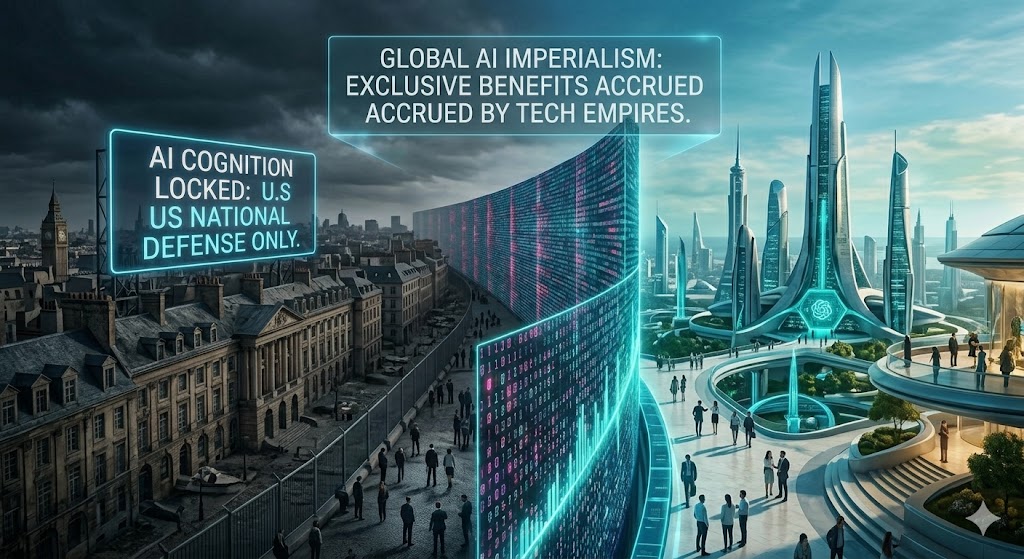
Economic nationalism and state capitalism converge, enabling superpowers equipped with massive tech monopolies to exploit global AI profits, talent, and capital.
Nations that fail to build indigenous AI technologies and proper domestic redistribution ecosystems face systemic collapse and stagnation, mirroring past economic crises.
[Real-world Signs] This is not a distant speculation. The recent emergency export restrictions imposed by the US government on Anthropic's ultra-high-performance AI models due to national security concerns prove this direction. Superpowers have already begun weaponizing "Cognition" itself within geographical borders, initiating the era of hyper-intelligence imperialism.
Resource constraints—including power shortages and semiconductor supply chain bottlenecks—cause the actual disruption of AI to materialize far slower than public anticipation.
Claims by corporations like OpenAI regarding the imminent completion of human-level Artificial General Intelligence (AGI) are analyzed as "technical bluffing" meant to attract capital. Real AGI remain at least 5 to 10 years away, forcing both nations and corporations into a prolonged transition period aimed at a soft landing.
Conclusion and Key Takeaways
"Abundance does not automatically equate to happiness. One must ride the wave and take ultimate responsibility for one's own life."
Financial abundance alone does not guarantee fulfillment. As observed even among ultra-wealthy individuals, the future utopia cannot be defined merely by financial surplus. The critical imperative is that as the global order changes rapidly, both individuals and enterprises must seize direct control and sovereignty over AI agents to avoid being left behind.
So What for ME
Step 1: Reposition as a Hard-Skill 'Strategist' and 'Reviewer'
Rote memorization, simple repetition, and standardized intellectual labor (hard skills) are handled by AI agents over 90% cheaper and faster than by humans. Therefore, you must completely transform the way you work.
From an Operational Worker to an 'AI Manager'
Spending time manually running Excel sheets, writing documents, and coding will now lead to obsolescence.
You must take on the role of a manager who handles multiple AI agents like subordinates, driving "Strategic Planning ➔ Work Instruction (Prompting) ➔ Final Decision-Making."
The 'Final Reviewer' Filling the 99% Accuracy Gap (Human-in-the-Loop)
No matter how advanced deep research features become, AI still maintains a 1–2% hallucination (error) rate.
The value of a 'human reviewer' who catches this critical 1% mistake and prevents risk will skyrocket. You must develop a sharp eye for "spotting errors" within your profession.
Step 2: Monopolize 'Soft Skills' (Human Relations and Problem Solving)
While the US administration can regulate cutting-edge AI models like Anthropic, it cannot control the trust and networks built within human society. You must fortify the uniquely human domains that machines cannot replace.
Persuasion, Negotiation, and Empathy
AI can generate a flawless report, but it is ultimately a human who takes that report to meet clients, persuade them, win contracts, and mediate conflicts.
The value of individuals with emotionally resonant soft skills will become increasingly exclusive.
Hybrid Capability (Convergence)
Specialists who dig into only one technical skill are highly vulnerable to AI.
For example, someone who possesses "accounting knowledge, knows how to utilize AI tools based on that knowledge, and directly handles client management (sales)" will never be replaced.
Step 3: Secure Digital Assets and the Means of Intelligence Production
In an era of 'hyper-intelligence imperialism' where the US and Big Tech monopolize technology, the key for ordinary citizens to protect their assets is to own the "means of intelligence production" or ride its momentum.
Launch a One-Person Agent Business
You must establish a one-person enterprise or a side project system that aggressively slashes costs by leveraging AI tools.
Become an 'AI-driven producer' who independently generates content, manages marketing, or operates e-commerce to build a foundation for capital income.
Hedge with Global Tech Monopolies and Assets
If a scenario where monopoly powers (Big Tech) holding technological sovereignty sweep up global wealth is highly probable, your personal asset portfolio must also focus on the global market leaders benefiting from that monopoly.
Diversify investments into tech infrastructure (AI semiconductors, energy, Big Tech) assets to defend (hedge) against the devaluation of your own wealth.
💡 In Summary
The most dangerous strategy for an ordinary citizen is 'studying hard and working diligently in the traditional way.' Becoming a planner who directs AI based on your professional knowledge, using human relationships and trust as your weapon, and running AI production means on a small scale is the most powerful survival strategy.
📌Teaser for the Next Article:
The previously discussed strategies—securing digital assets and building hybrid capabilities—demand rigorous metacognition and a strong willingness to take risks. But what if this entrepreneurial mindset simply doesn't align with who you are?
If it doesn't fit, it's time to pivot your strategy.
In the next article, we deliver hard-hitting, realistic critiques alongside practical alternatives: how to become the ultimate partner to an AI planner, how to thrive as an analog artisan outside the screen, and how to effectively leverage the trickle-down effects of the system.
👉 [Related Article] The Dangerous Fantasy of “Everyone Becoming an AI Planner”
#AISurvivalStrategy #AIAgents #HumanReviewer #SoftSkills #HybridCapability #Solopreneur #TechHedge #BigTechInvestment #AIPlanner #FutureOfWork #OwningMeansOfProduction #AIBusiness
Support the independent voice of Ludens Times
Today's Reflection
Record your daily action inspired by today's article.
The Ludens Times Digest
Get our latest inspirations delivered straight to your inbox.