
In the Era of Zero-Cost Intelligence, Humanity's Final Economic Moat is 'Human Connection'.
As the explosive computational power of artificial intelligence and AGI entirely overwhelms human intellectual labor, the exchange value of knowledge is strictly converging to zero. In the face of an overwhelming system restructuring beyond individual control, completely withdrawing one's defensive mechanisms and coolly observing the macro-level migration paths of capital will serve as a practical survival strategy. Facing the macroeconomic structure where intellectual assets have been reduced to mere commodities is the very first step of business.
Even at this inflection point where the supply cost of intelligence plummets, the only scarce asset that remains intact is the biological human desire for belonging. In an environment where infinite virtual data is duplicated, capital instantly pivots toward physically-based communities where tangible interactions are guaranteed. The metrics prove this: while the heavily funded, non-face-to-face online education market stagnates, the profitability of small-scale academies selling face-to-face human connection is skyrocketing. The explosion of offline traffic on region-based secondhand trading platforms shares exactly the same causal relationship. As the fatigue from digital connectivity accumulates, the real, physical instinct to gather is immediately capitalized.
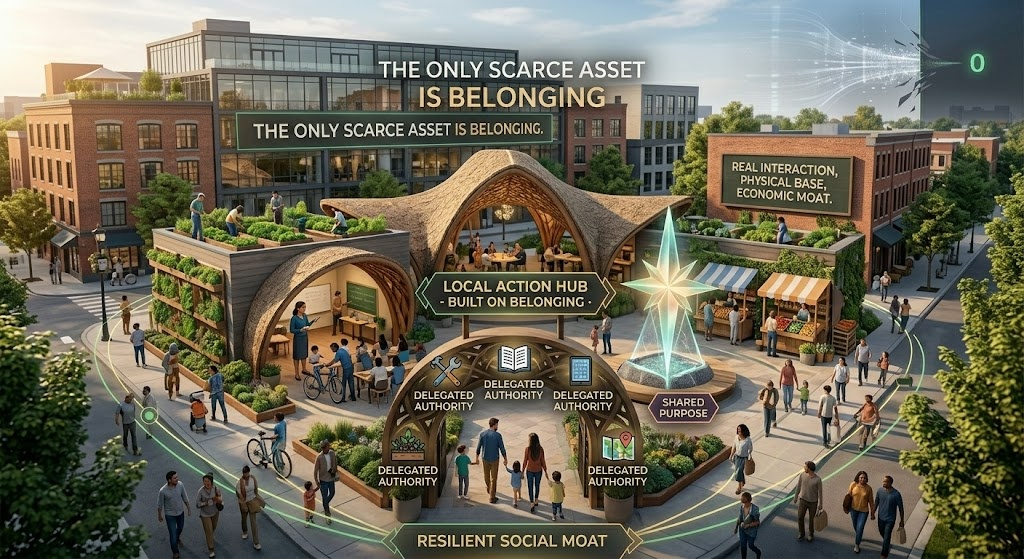
The first causal law of building a community that rallies the public and attracts market capital is the design of a transparent sense of purpose. To make members willing to pay the opportunity costs of their physical time and labor, they must be given a specific goal that resolves practical deficits, such as balancing work and childcare or participating in local cleanup efforts. This designed purpose must be continuously published through the platform as clear content in the form of text and video. While the simple listing of information is instantly replicated on data servers, content containing a directional call to specific actions operates as a filter that powerfully binds sporadic demand into a homogeneous group.
The long-term survival of a group depends on the design of a specific system known as the delegation of authority. A centralized structure where a single founder monopolizes decision-making will inevitably collapse as it hits the physical limits of scalability. Just as global sports brands expanded their market share by distributing store operation authority to local yoga instructors, one must thoroughly transfer practical roles and duties to internal members. Humans form a resilient attachment exclusively to subjects in which they have directly invested their own scarce resources. The key is to concentrate capital and rewards on the vital few who drive results, making them function as voluntary external expansion channels.
The technological superiority of a product or simple price competitiveness are superficial, lagging indicators that are easily replicated once massive dollars are injected. The densely accumulated social connection within a platform is a firm barrier to entry that can never be imitated, even by colossal algorithms. Maximizing structural switching costs so that leaving the service directly translates to the loss of acquired vested rights is the essence of an economic moat. We have already entered the ruthless trajectory of a hegemony shift, where overwhelming superintelligence and capital combine to monopolize the global industrial ecosystem entirely. In a world where intelligence has been standardized, the control over a group's sense of belonging is the only absolute asset.
Reference
부자들이 주목하는 AI 시대 살아남는 법
So What for ME
How I Am Reallocating My Resources in the Age of AI
Over the past few years, artificial intelligence has advanced at an extraordinary pace. No one can say with certainty how far these technologies will go or exactly how they will reshape society and our daily lives.
What seems clear, however, is that periods of rapid change force us to think more carefully about where we invest our time, energy, and attention.
In this environment, I find myself paying increasing attention not to technology itself, but to human connection. Information and knowledge are becoming more accessible than ever before, yet the experience of spending time with others, building trust, and forming meaningful relationships remains difficult to replicate.
What I Consider Important
Moving beyond passive information consumption and creating opportunities for genuine human interaction.
Expanding connections not only online but also within local communities and real-world environments.
Rediscovering the value of face-to-face interaction as a balance to growing digital fatigue.
The Mindset I Try to Maintain
Technological change is largely beyond the control of any individual. Rather than focusing on forces I cannot control, I prefer to focus on actions that are within my reach.
Concentrate on practical action rather than fear of future technological change.
Reevaluate how I allocate my time and resources as the environment evolves.
Remember that trust, cooperation, and social bonds continue to matter regardless of technological progress.
Areas That Deserve More Attention
I believe small, purpose-driven communities may become increasingly valuable in the years ahead.
Whether centered around learning, parenting, hobbies, volunteering, health, or local initiatives, such groups often provide more than information. They offer encouragement, accountability, belonging, and opportunities for shared growth.
These experiences represent forms of value that technology can support but may never fully replace.
Practical Ways to Act
Participate in or help organize local community activities and small group gatherings.
Contribute to real-world efforts such as event planning, space management, or educational programs.
Create environments where people can actively participate, collaborate, and grow together.
Technology will continue to evolve, and many aspects of life will undoubtedly change with it.
At the same time, it may be worth remembering that as technology becomes more capable, the value of trust, belonging, and meaningful human relationships may become even more significant.
I do not believe that I can accurately predict the future. However, the more rapidly the world changes, the more meaningful it seems to me to value real human connections and create spaces where people can learn and grow together, because that is what I truly want to focus on right now.
Support the independent voice of Ludens Times
Today's Reflection
Record your daily action inspired by today's article.
The Ludens Times Digest
Get our latest inspirations delivered straight to your inbox.