
[Part 2] The AI Era: Where is the Money Flowing Next?
The core narrative is not about Bitcoin.
Rather, it is the structural migration of capital:
AI Infrastructure → Data Centers → Energy/Power → SMRs/Cooling → Physical AI.
The robot vacuums and serving robots we use today are not true Physical AI. Today, Physical AI is evolving into a stage where it understands language, perceives visual information, judges situations, and executes actual physical actions. For example, if a person says, "Pick up that apple in front of you," a true Physical AI recognizes the apple, understands the user's command, and picks it up with the appropriate amount of force. Moving forward, this technology is expected to expand rapidly into manufacturing, logistics, automotive, and robotics.
While NVIDIA creates top-tier GPUs, it does not possess actual manufacturing data. This makes collaboration with South Korean enterprises critical. Key players frequently mentioned include:
• Samsung Electronics
• SK Hynix
• Hyundai Motor Company
• LG Electronics
• Naver
• Doosan Robotics
• SK Telecom
• Doosan Enerbility
These companies act as both suppliers and customers. In short, South Korea is a vital partner for building the foundational Physical AI ecosystem.
In the past, proficiency with office software was a competitive edge; in the future, utilizing AI will be a baseline capability. Furthermore, in the era of AI agents, AI will likely drive the execution of work, while humans shift to defining directions, reviewing outputs, and making final decisions. Ultimately, competitive advantage will belong to those who know how to properly utilize AI, rather than those who simply possess a vast amount of personal knowledge.
Evolution of AI Payment Systems: As AI moves beyond merely providing information to independently making decisions and executing tasks, payment systems must change accordingly.
Transaction Architecture for AI Agents: When AI agents start selecting services, communicating with other AI systems, purchasing necessary resources, and paying for outputs on behalf of humans, they will require a fast, low-cost payment method.
The Role of Stablecoins: This is where stablecoins become essential.
Payment Efficiency: Stablecoins are faster and offer lower fees than traditional cross-border remittances or international payments, operating seamlessly on a dollar-pegged basis.
Suitability for AI Payment Infrastructure: In an ecosystem where AI systems exchange services and handle transactions peer-to-peer, stablecoins serve as a highly compatible financial infrastructure.
Expansion of Financial Infrastructure: Legacy financial networks may not suffice for the AI era. Stablecoins can serve as the new financial layer connecting AI services, on-device AI, physical AI, and global digital commerce.
Strategy for Maintaining Dollar Hegemony: For the United States, stablecoins are not just crypto products; they are a strategic tool to maintain US dollar hegemony in the digital age.
Controllability Compared to Bitcoin: Bitcoin is a premier digital asset characterized by decentralization and scarcity, but it limits direct US design or control. In contrast, because stablecoins are pegged to the dollar, they are far more effective for maintaining or extending the dollar's influence within global digital payment networks.
Payment Scalability in the AI Era: Global digital transactions will likely accelerate with the rise of AI. If the baseline unit for these transactions settles on dollar-based stablecoins, the US can preserve its dollar-centric order in the digital financial era.
Core Policy Takeaway: When analyzing US crypto strategy, observing stablecoin institutionalization and the expansion of dollar-based payment networks is more critical than tracking Bitcoin prices.
Polarization of AI Literacy: The Reality of the Gap. Over the roughly four years since launch, a significant capability gap has emerged between high-skilled users and those indifferent to the technology.
The 5 Stages of Psychological Transition (Kübler-Ross):
Denial: An early-stage stance where self-employed individuals and field workers dismiss the technology, claiming, "My job cannot be replaced."
Anger & Depression: A sense of deprivation experienced firsthand upon witnessing workforce reductions or creative disruption, such as AI music technology generating full tracks in 30 seconds.
Bargaining & Acceptance: The final psychological shift where individuals acknowledge the technology's capability and adapt to the system for survival.
Recognizing the Era of AI Agents: Structural Role Reversal. A major shift where AI leads the end-to-end workflow while humans pivot to a supporting, supervisory role.
Securing Unique Human Capabilities:
Prompt Control: The tool-handling capability to structure questions and feed high-quality data to AI to derive optimal outputs.
Final Data Verification: The critical capacity for humans to evaluate the reliability and accuracy of intermediate and final outputs generated by AI systems.
A Step-by-Step Approach to Accumulating Literacy:
Turning Experience into Fuel: Avoiding paralysis in the face of massive change, and instead building a habit of applying AI to small, daily tasks to experience its utility.
Survival Strategy: Transforming into talent that commands technology and proves unique human value by progressively upgrading utilization skills.
The core of this discussion is that these technologies and assets cannot be viewed in isolation. Bitcoin is the flagship asset of the crypto market, but institutional restructuring is currently more critical than its price. Quantum computing poses a threat to legacy cryptographic systems, yet it simultaneously drives discussions on quantum-resistant cryptography and security upgrades.
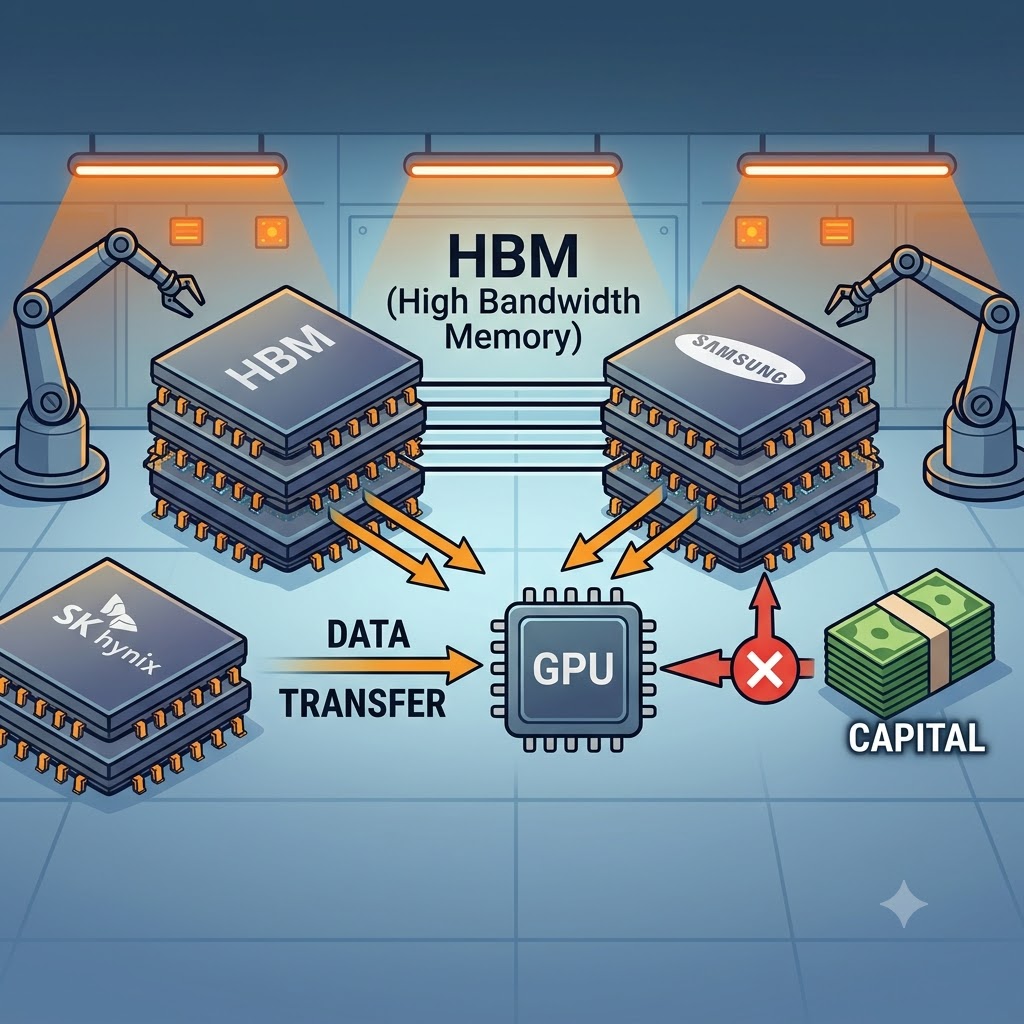
AI is not in a bubble; it is in an initial infrastructure build-out phase that links GPUs, HBM, data centers, power grids, SMRs, and underwater data centers. Physical AI represents the expansion of AI into the physical world, a process where South Korea serves as a vital partner owing to its comprehensive infrastructure spanning manufacturing, semiconductors, automotive, consumer electronics, telecommunications, and power.
Stablecoins serve as the payment infrastructure for the AI era and a core vehicle for the US to sustain dollar hegemony in the digital age. Ultimately, upcoming shifts will not occur within a single sector. AI, semiconductors, power grids, nuclear energy, data centers, robotics, automotive, crypto, stablecoins, and dollar hegemony are converging into one massive, interconnected macroeconomic flow.
Bitcoin: Potential for stagnation rather than short-term surges; requires confirmation of institutional changes; lends itself to a dollar-cost averaging strategy.
Stablecoins: Linchpin of US financial hegemony strategy; expands digital payment infrastructure.
AI: Early-stage phase focused on building infrastructure rather than a speculative bubble.
Semiconductors: Driven by GPU & HBM demand.
Data Centers: Core AI infrastructure; the next upcoming bottleneck.
Power: The largest potential bottleneck.
SMR (Small Modular Reactors): Critical power supply solution for the AI era.
Cooling Tech: Essential for maximizing data center efficiency.
Physical AI: Highly likely to scale across manufacturing, automotive, robotics, consumer electronics, and logistics.
To understand the AI era, one cannot look at AI alone. AI requires semiconductors, semiconductors require data centers, and data centers require power. Power constraints invite new infrastructure alternatives like SMRs and underwater data centers, while Physical AI demands manufacturing, robotics, automotive, consumer electronics, and telecommunications infrastructure.
Furthermore, as AI advances to the stage of autonomous decision-making and execution, payment systems must evolve. This is precise point where stablecoins enter the equation. Bitcoin, quantum computing, AI, SMRs, Physical AI, and stablecoins are not isolated topics. They are interconnected pieces of a puzzle forming a new digital order. The key moving forward is not guessing a single winning asset, but reading where this massive structural shift creates bottlenecks and where it unlocks new opportunities.
Source: Key Variables for Bitcoin Investors
[Part 3] The Age of Ownership, Not Labor: A Personal Survival Strategy for the AI Era
Support the independent voice of Ludens Times
Today's Reflection
Record your daily action inspired by today's article.
The Ludens Times Digest
Get our latest inspirations delivered straight to your inbox.