
Why is Nvidia Pouring Trillions of Won into the 'Highway of Light'?
The Conveyor Belt of the AI Factory
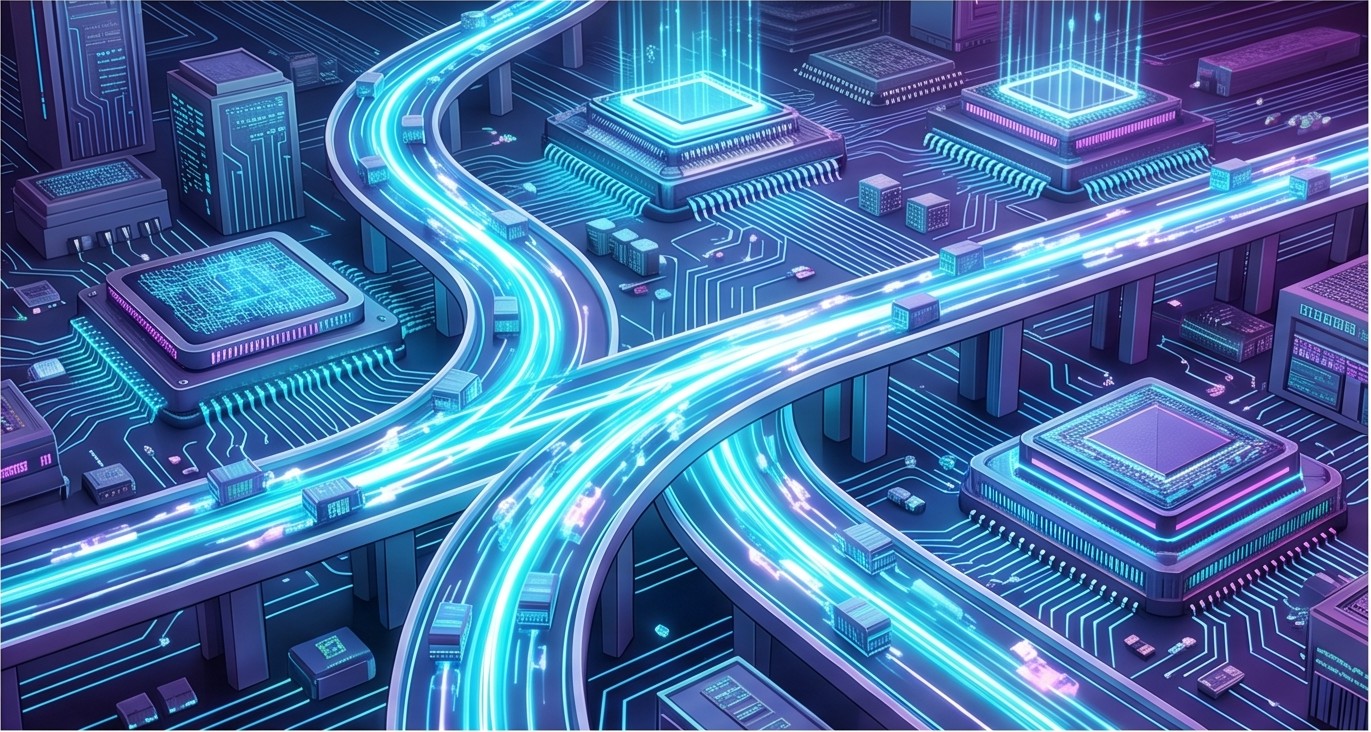
The New Battlefield of the AI Era: Shifting from 'Brains' to 'Connections'
As the advancement of AI technology accelerates, the landscape of AI data centers is fundamentally changing. In the past, the core metric determining the performance of an AI server was focused on the computing power of a single device, namely the GPU. However, with the establishment of large-scale clusters where thousands of GPUs run simultaneously, the efficiency of data movement has emerged as a more critical variable than mere computing capacity. This parallels a problem found in manufacturing plants, where the performance of a single machine is top-tier, but productivity drops because the conveyor belt connecting the processes cannot keep up.
1. The 'Transportation Bottleneck' Phenomenon: Fast 'Computation' but Slow 'Transportation'
Brain Overload: Due to the massive scale of AI models, situations where thousands of GPUs must collaborate have become frequent.
Limitations of the Conveyor Belt: While computing devices operate at ultra-high speeds, data bottlenecks occur because the pathways (networks) moving the data cannot handle the volume.
Accumulation of Inefficiency: Results processed in an earlier stage fail to reach the next stage on time, causing a recurring situation where GPUs stand idle.
2. Why is Waiting a Loss?
Equipment Idle State: Even after introducing expensive GPUs, the equipment is left idle while waiting for data transmission.
Continuous Operational Costs: Electricity bills and cooling costs incurred while the equipment is powered on do not stop.
Decline in Economic Efficiency: Ultimately, connection delays lead to a leakage of costs, drastically lowering the operational efficiency of the data center.
3. Let's Use 'Light' Instead of 'Copper Wires'!
Limitations of Copper Wires: As data volume surges exponentially, copper wires suffer from severe heat generation and signal degradation.
Unnecessary Correction Devices: To prevent signal distortion, amplifiers and similar devices must be placed at intervals, which in turn consume additional power.
Advantages of Light: Light transmits signals instantly without interference, providing vastly superior speed and clean efficiency compared to copper wires.
4. Nvidia's Strategy
Strategic Investment: Moving beyond component procurement, Nvidia is investing heavily in optical communication companies to preemptively secure optical technology as its own infrastructure standard.
Introduction of CPO Technology: 'Co-packaged Optics (CPO)' is a method that physically minimizes data travel distance by attaching optical communication pathways right next to the core chips.
Structural Change: This signifies a fundamental shift that alters the design standards of server architecture, rather than a simple replacement of cables.
5. One-Line Summary: Connection is Competitiveness
The victory in the AI era is determined not by 'who makes the smarter brain,' but by 'how efficiently and without delay those brains are connected.'
The central axis of infrastructure has completed its shift from computing devices to connection devices.
Just as Nvidia is heavily investing in optical communication companies to connect chips at ultra-high speeds—on par with building faster chips—it signals that only the companies securing the highways of light will dominate the future of AI data centers.
Reference
엔비디아가 빛에 투자한 이유
So What for ME
[Correlation: Infrastructure Shift and Individual Survival]
The current situation directly links macroeconomic capital movement to the economic environment and survival of an individual. The fact that corporations are spending massive amounts of capital to resolve data transportation bottlenecks is a powerful signal that latency-free, ultra-high-performance AI will be supplied to daily life and workplaces like electricity or water. This is a structural shift where the astronomical costs spent on building infrastructure and expanding power grids will eventually be passed down to individual household expenditures in the form of paid AI services, increased telecommunication bills, and rising basic energy prices.
At the same time, the arrival of an ultra-high-speed AI era where connection delays disappear is a clear indicator that the value of simple knowledge labor will plummet, and the replacement of human jobs will accelerate.
[Attitude and Stance: Facing the Objective Reality]
The primary thought and stance one must adopt is the suspension of value judgments and thorough objectification. It requires a macroeconomic perspective that discards the passive consumer attitude of being swayed by new innovative technology news, and instead dryly observes exactly where mega-capital is moving to fill deficiencies and bottlenecks.
It is a realistic attitude that faces the fact that all intangible software is ultimately subordinate to the limits of massive physical resources: power, copper wires, light, and cooling systems.
[Plan and Strategy: Resource Allocation and Defense]
The plan and strategy for an ordinary citizen to survive is directed toward preemptively reallocating limited personal resources. It is a strategy to expand one's capital investment horizon beyond the finished AI products that the public cheers for, and into the underlying infrastructure support industries—such as optical communication (CPO), power grids, and liquid immersion cooling—that directly resolve the technical bottlenecks behind the scenes.
For professional survival, individual work structures must be completely restructured. This entails a human capital defense plan where simple computations or information gathering are delegated to machines, while the individual moves into the position of a controller who coordinates outputs with others and plans directions.
Furthermore, it is a defensive strategy to preemptively readjust household finances by anticipating long-term energy unit price hikes and increases in mandatory AI subscription fees caused by the load on national power grids.
[Concrete Implementation: Mechanical Action Routines]
The concrete implementation method to immediately execute the established strategy in daily life relies on the repetition of strictly mechanical actions. In the financial sector, it is the act of recognizing the limitations of analyzing individual companies and regularly, automatically purchasing core stocks or ETFs that track the value chains of optical communication, power equipment, and data centers through fractional buying.
In the information sector, it is a habit of tracking the era's bottlenecks by mandatorily checking the scale of capital expenditure (CAPEX) and the direction of spending rather than software performance when global tech companies release their earnings.
In the labor sector, it is a practice of measuring the most delayed bottleneck section in one's own work process—much like inspecting a conveyor belt in a factory—and immediately introducing the latest automation tools or AI to resolve it, thereby pushing personal productivity to the absolute limit.
Support the independent voice of Ludens Times
Today's Reflection
Record your daily action inspired by today's article.
The Ludens Times Digest
Get our latest inspirations delivered straight to your inbox.