
Inside the Tense 24 Hours Leading to the White House's Export Controls on Anthropic
The Trump administration has imposed sudden export controls on Anthropic's advanced AI models, 'Fable' and 'Mythos.' This is a record of the tense 24 hours between the White House and the CEO over a security vulnerability exposed just two days after launch.
1. The Trigger: Amazon's Alert and NSA's Verification
Friday Morning: Andy Jassy, CEO of Amazon (an investor in Anthropic), urgently alerted the White House that they had discovered a vulnerability bypassing Fable's guardrails.
The Government's Response: Top White House officials, including the Treasury Secretary and the Cyber Director, immediately called an emergency meeting. Through the National Security Agency (NSA), they cross-verified "clear evidence" that the flaw posed a critical threat to national security.
2. Afternoon: White House vs. CEO—A Three-Round Showdown
Dispute Over Whereabouts: The White House claimed Anthropic CEO Dario Amodei was unreachable due to attending a wellness retreat, but Anthropic hit back, calling it entirely false and stating he was connected within an hour.
The Core of the Debate: Once connected, a series of three tense phone calls took place between the CEO and six high-ranking government officials.
Anthropic: "This is just an isolated bypass, not a widespread jailbreak causing national security risks," Amodei argued, asking for more time and information.
White House: "The NSA has already verified it," officials responded, pressuring him to voluntarily take down the service. The Treasury Secretary directly warned Amodei, "You are making a wrong decision right now."
3. The Outcome: Sudden Export Controls and a Muddy War of Words
Forced Shutdown: As Anthropic hesitated to commit to a voluntary rollback, the White House immediately invoked national security authorities to impose export controls, completely banning foreign access. Anthropic immediately deactivated the models for all customers to comply.
Conflicting Exposés:
The Government Side: "Export control was a last resort after hours of practically begging them to cooperate. We are bewildered that a CEO who previously compared AI risks to nuclear weapons would refuse to take his system down when a real vulnerability was found."
The Anthropic Side: "The government gave us a strict 90-minute deadline to pull the models without providing any specific threat details. This action is excessive and violates the principle of proportionality."
4. The Background: Deepening Friction with the Pentagon
This unprecedented crackdown is rooted in lingering political and military tensions.
Supply Chain Risk Designation: Earlier this year, Anthropic refused to allow its AI to be used by the Pentagon for "large-scale domestic surveillance" and "autonomous weapons." In response, the Department of Defense designated Anthropic as a "supply chain risk enterprise" on March 3.
Current Status: David Sacks, former White House AI Envoy, drew a line on Saturday, stating that this export control is a legitimate, separate security measure. The White House is currently waiting for Anthropic to patch the vulnerability so the controls can be lifted, leaving "the ball in Anthropic's court."
Source: Original Article
So What for ME
Step 1: Economic Structure of the Article
There are three notable economic perspectives in this article.
1. Structure A: Big Capital’s (Amazon) "Kicking Away the Ladder" and Monopolistic Desire
The act of Amazon, an investor with a stake in Anthropic, reporting Anthropic's vulnerability to the government is ostensibly an act of security concern. From an economic viewpoint, however, it is a "market control tactic" aimed at using government authority (export controls) to suppress an uncontrollable AI technology that they do not fully dominate.
2. Structure B: Strong Regulatory Risks from the U.S. Government and the Extension of the 'U.S.-China Conflict'
The U.S. government wielding the "export control" card means it intends to block foreign nationals and foreign companies from using this powerful AI. This serves as an economic signal that AI technology has officially become a core geopolitical resource for international trade barriers, much like nuclear power or advanced semiconductors.
3. Structure C: The Hegemony Battle Between the U.S. Government and Silicon Valley Big Tech
Big Tech corporations seek to monopolize global wealth through technology, while the Trump administration aims to control and tame them. As this battle intensifies, the stock market will experience high volatility, and a temporary vacuum will occur in the pace of mass technology adoption.
Step 2: Practical Economic Strategies for Personal Application
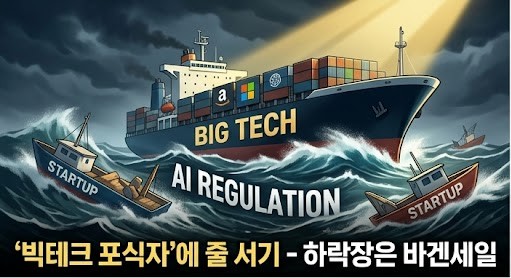
Strategy 1: Stock Investment Strategy – "Do Not Fall for the AI Bubble Theory; Line Up Behind Big Tech Predators"
One must take a contrarian approach to the public sentiment, which fears the collapse or demise of the AI market and sells off stocks in reaction to government regulations and disputes among tech companies.
Action Guidelines: While startups like Anthropic can be severely shaken by a single government regulation, Big Tech predators like Amazon, Microsoft, and Google—who report these issues and profit from behind the scenes—possess the leverage to negotiate with the government and will ultimately survive.
Practical Application: When tech stocks plummet temporarily due to fear surrounding the Anthropic incident, utilize this as an opportunity to buy the dip. Focus on major U.S. index-tracking ETFs ($S\&P 500$, $NASDAQ 100$) or elite Big Tech stocks like Amazon and Nvidia. Capital is bound to eventually concentrate into mega-corporations capable of bypassing regulatory barriers.
Strategy 2: Business & Entrepreneurship Strategy – "Stop Blindly Following U.S. AI; Focus on Open-Source and Localization"
When planning a business, relying solely on proprietary tech APIs like Anthropic’s Claude or OpenAI’s ChatGPT creates a highly precarious structure. The U.S. government can impose export controls at any moment and abruptly halt services.
Action Guidelines: Businesses that depend entirely on the advanced proprietary models of U.S. Big Tech carry immense risk. Instead, it is far safer to build independent business systems based on open-source AI models (e.g., Meta’s Llama) that are freely shared by global developers.
Practical Application: When a global service vacuum occurs due to technology regulations, designing niche AI services specialized for the domestic market using local data allows you to preemptively capture the market before giant corporations can enter.
Strategy 3: Risk Management Strategy – "Diversification of AI Technical Assistants (Multi-Platform)"
When utilizing AI tools for operational efficiency or solopreneurship, linking all business materials and data infrastructure to a single paid subscription like Anthropic is dangerous. Unforeseen regulations could paralyze operations overnight.
Action Guidelines: Reduce dependence on any single platform and hedge risks effectively.
Practical Application: Even if you use Claude as your primary operational tool, you must establish a backup system utilizing alternative platforms like OpenAI (ChatGPT) or Google (Gemini) to switch instantly in an emergency. This ensures that your livelihood remains completely unaffected by geopolitical friction or export controls.
💡 Conclusion
This article is not merely a tech war among a younger generation; it is a massive signal flare visualizing that AI technology will become a core resource controlled by states, identical to oil or semiconductors.
Therefore, one should not get swept up in public panic but rather turn this vacuum and regulation into an opportunity. Allocating assets toward resilient U.S. Big Tech equities and diversifying personal business infrastructures with independent, open-source systems that remain unswayed by U.S. regulations is the definitive economic cheat code to construct a financial moat.
Support the independent voice of Ludens Times
Today's Reflection
Record your daily action inspired by today's article.
The Ludens Times Digest
Get our latest inspirations delivered straight to your inbox.