
Five Structural Flaws in Today’s AI Survival Strategy Narrative
The Harsh Reality Hidden Behind the Illusion of Total Specification
"Everyone must become an AI planner or transition into a solo entrepreneur."
In today’s tech market, this statement is repeated so often it has practically become common sense. However, this discourse harbors a profoundly serious flaw.
Every individual is born with a different disposition, a unique threshold for enduring stress, and a distinct mechanism for rebounding from failure. Yet, contemporary narratives completely ignore these individual differences, demanding that everyone sprint toward the exact same style of credential and skill competition.
But there is an even more critical issue at hand. This entire argument relies entirely upon a single, unquestioned premise:
In the AI era, highly competitive individuals will ultimately survive.
Is that truly the case?
Experts at a recent forum predicted that in the near future, a single professional will work alongside and manage more than 100 autonomous AI assistants. This implies that a company's core competitive metric will shift from its headcount to how many AI agents a single employee can effectively operate. ( View Related Article )
On the surface, this looks like an explosive surge in personal productivity. However, the narrative shifts entirely when context is applied: an environment defined by accelerating technological cycles, shrinking career lifespans, and collapsing income predictability. In fact, as AI normalizes and elevates basic personal productivity across the board, the traditional formula for competition—“I can gain an edge if I build slightly better credentials than others”—crumbles. Success or failure will likely be dictated not by individual skill sets, but by whether one holds structural and systemic advantages, such as:
Capital
Networks
Data
Platform Access Rights
Let us dissect the five structural flaws embedded within the survival strategies currently being pushed in the AI narrative.
1. Survival is Determined by Defensive Capability, Not Offensive Power
Most career strategies focus heavily on maximizing productivity and income.
Earn more.
Grow faster.
Secure a sharper competitive edge.
This is entirely offensive-minded thinking. However, as volatility intensifies, survival is dictated not by your offensive capability, but by your defensive capacity.
This holds particularly true in an environment where AI rapidly drives down the production cost of knowledge work. As the scarcity of knowledge collapses, any operating model that maintains high fixed costs while relying solely on continuous income growth becomes dangerously fragile.
Ultimately, the core question is this:
While the vast majority of AI discourse centers exclusively on "how to earn more," a far more powerful strategy in reality may be "how to require less."
You do not necessarily have to win the competition to survive. Lowering your fixed cost of living and optimizing your consumption patterns to establish a low-cost structure is a highly viable alternative. Sometimes, rewriting the rules of the game entirely is far more realistic than trying to fight better within an existing system.
2. Technological Evolution and Social Adaptation Move at Different Speeds
Many fall victim to a common illusion: AI is advancing rapidly, therefore society will transform instantly.
Reality is never that simple. The speed of technological development and the speed of societal adoption operate on completely different timelines. A massive friction always exists between the two, driven by factors such as:
Government regulations
Ambiguity in liability and accountability
Legal risks
Inertia within legacy organizations
Conflicts of interest
Historically, it took decades after the invention of electricity for actual factory productivity to experience a measurable surge. AI is no different. The mere existence of a technology does not instantly re-engineer an entire society. Therefore, blindly rushing to the absolute front line of AI is not the only valid answer.
In fact, migrating deliberately into domains where AI penetration is structurally bound to be slow is an incredibly strategic move. Examples include:
Public institutions
Administrative systems
Institutional education
Healthcare assistance
Regulated industries
The temporal buffer created by regulation serves as a remarkably powerful shield. During that granted grace period, we can execute much more fundamental, structural adjustments.
3. The Belief That Analog Domains Are Safe is a Misconception
The claim that “the offline, analog world is safe” is only half true. To be precise, it is not safe; its automation is merely delayed.
The moment AI integrates with humanoids and expands its footprint into the physical world, the paradigm shifts. Sectors like manufacturing, logistics, transportation, and on-site field operations will inevitably face mounting pressure to automate. Therefore, the dividing line is not whether an industry is digital or analog.
The true variable is the nature of the task. Any role that can be codified, manualized, and mapped to clear, repetitive patterns will ultimately fail to escape automation pressures.
Conversely, the tasks most likely to endure until the very end are those involving:
Instantaneous judgment during unprecedented emergencies
Navigating complex human emotions
Solving unstructured, non-linear problems
Safety zones do not exist within specific industries; they exist within the depth and complexity of the specific task.
4. The Market Value of Human Labor Itself May Shake
Most AI survival strategies operate under a singular assumption: In the future, humans will continue to labor to earn money.
Yet, this very premise is vulnerable to destabilization—especially when AI progresses to the stage of autonomously engineering superior iterations of AI. When this phase begins in earnest, the fundamental question shifts completely.
Until now, the questions have been:
What technology should I learn?
What profession should I pursue?
In the future, however, the question converges into:
Should this question become reality, traditional credential-and-specification-driven strategies will be largely rendered obsolete. What remains at that point is out-of-market value. This does not imply the end of the monetary economy. The meaning is far simpler: human-centric values that AI cannot replicate, such as:
Deep trust
Emotional bonds
Local communities
Physical assets
Self-sufficiency capabilities
Trust-based exchange networks
As the market destabilizes, these specific values are highly likely to command a premium.
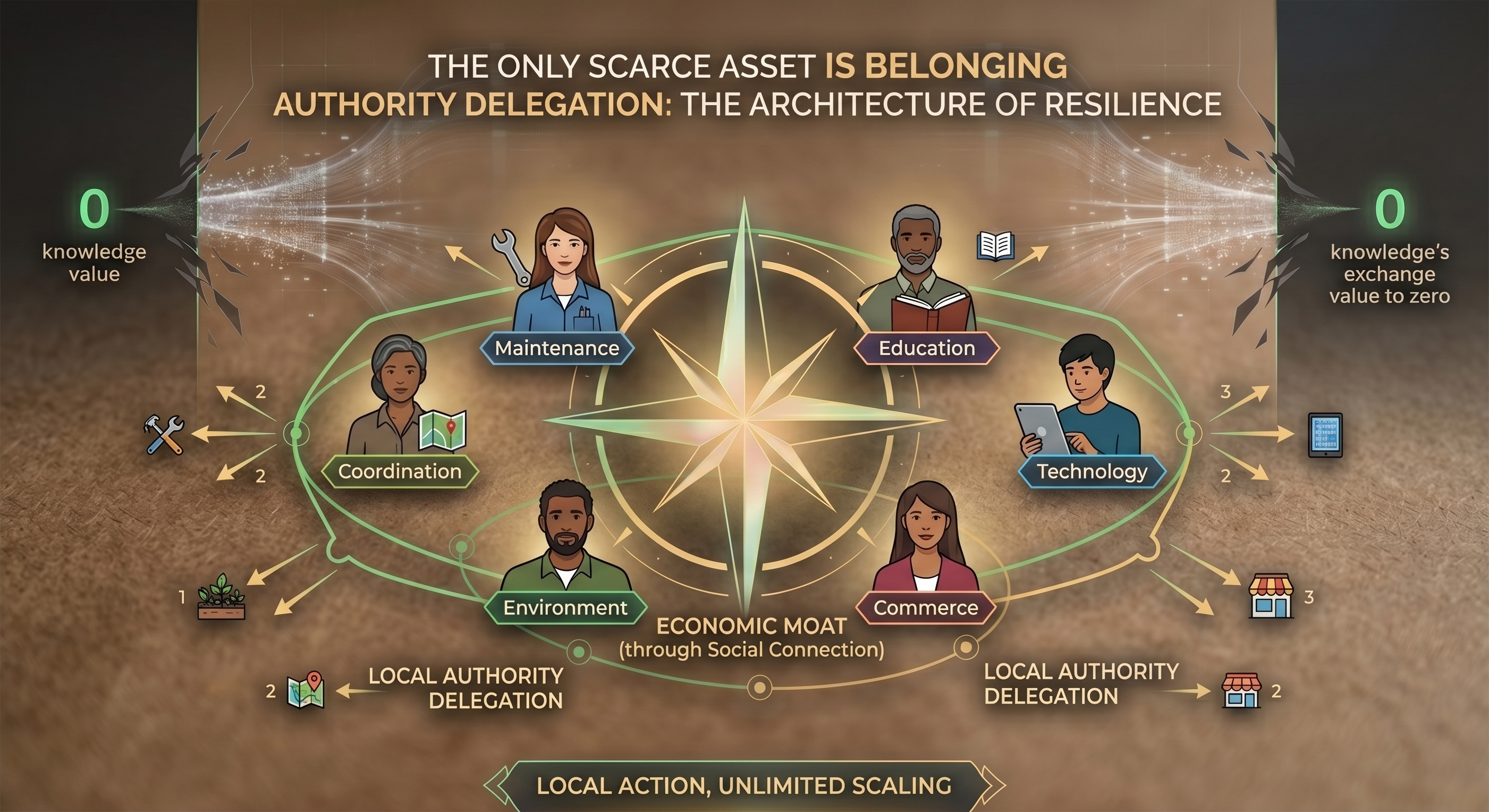
5. AI Survival Discourse is Overly Individualistic
This is the single greatest structural defect of the current narrative. The vast majority of AI commentary addresses the individual in isolation:
What will you learn?
What skills will you master?
How will you increase your competitiveness?
Historically, however, humans have never survived in isolation. We survived as collectives.
Consider two profiles: an isolated individual possessing exceptional technical specifications versus an individual with average technical skills but embedded within a highly cohesive network. Who will endure longer? The answer is far from simple.
In the future, a much more powerful defense mechanism than a flashy individual resume will be:
Which network of trust do I belong to?
A robust community, a small network that practices mutual accountability, and a web of collaborative relationships—this is the thickest armor an individual can wear in an era defined by hyper-fragmented survivalism. ( View Related Article )
Conclusion: Upon Which System Do You Stand?
Survival strategies for the artificial intelligence era cannot be neatly reduced to oversimplified directives like "Become an AI planner" or "Become an artisan." Perhaps the truly vital question we must ask ourselves is not “How do I become stronger?” but rather:
Within which system will I choose to live?
The future survivor may not necessarily be the smartest individual or the one standing at the absolute bleeding edge of technology. Instead, those who are highly likely to survive longer and with greater stability are:
Those who have optimized their cost structures.
Those who have migrated into domains of slower transitions.
Those who have secured a resilient, high-trust community.
Those who have accumulated value outside the traditional market.
What we need right now is not to relentlessly drive ourselves forward under the pressure of endless competitive narratives. First and foremost, we must dispassionately evaluate one reality:
What kind of structure am I currently standing on?
So What for ME
How to Stop the Era of Hyper-Fragmented Survivalism: 3 Survival Systems You Must Build Right Now
What, then, should we apply to our daily lives today?
To break free from macroeconomic fatigue, we must now let go of our habitual drive to pile up traditional credentials and instead design a structural shield to protect ourselves. Here are the three core practical manuals that must be executed immediately to secure the long-term sustainability of our lives.
Step 1. Financial Optimization: Establishing a 'Survival Baseline' and a Living Expense Buffer Zone
The most powerful weapon in the artificial intelligence era is not a high income, but rather aAs unpredictable volatility intensifies, the first step is to construct a financial structure that does not collapse.
Action Item: Review your expenditure history over the past three months and create a detailed list of "fixed expenses incurred simply by breathing" (e.g., housing costs, insurance premiums, regular subscriptions, loan interest, etc.).
Checklist Question: If your primary source of income were cut off tomorrow, how many months could you endure with your current assets and fixed-cost structure?
Action Guidelines: Strip away 20% or more of unnecessary fixed expenses and visualize the absolute minimum maintenance cost of your life. Based on this, prioritize securing a "6 to 12-month living expense buffer zone (financial reserve)." This allows you to plan your next strategy with peace of mind, even when the market destabilizes.
Step 2. Shifting the Nature of Tasks: Realigning Your Work Weight Toward a 'True Safe Zone'
You must dispassionately distinguish whether the industry you belong to is merely a "delayed zone" where automation arrives slowly, or a "true safe zone" that is structurally difficult for technology to penetrate. The key lies in the actual nature of the specific tasks you perform within your job.
Action Item: Breakdown and record the tasks you handle throughout a single day into percentages of: "simple repetition/data compilation," "situational judgment/coordination," and "face-to-face contextual communication."
Checklist Question: Out of the tasks I processed today, how much could be replaced by artificial intelligence if standard manuals and data were provided?
Action Guidelines: Intentionally reduce the proportion of simple manual labor or data gathering tasks. Instead, elevate the proportion of your current work to 70% or higher in areas such as: solving unprecedented emergencies that cannot be manualized (unstructured problem solving), deep contextual communication with clients, and coordinating conflicting interests among multiple parties (soft skills). Additionally, cultivate "one alternative pipeline of side income" capable of surviving independently if single contracts decouple, alongside a "basic understanding and application capability of AI" so you do not become subordinated to technology.
Step 3. Visualizing Relationship Assets: Connecting Your Unique 'High-Cohesion Small Community' and Physical Assets
We live in an era where massive platforms or corporate systems no longer take responsibility for the individual. Moving away from system dependency, independent individuals must proactively design a reciprocal system where they support one another.
Action Item: Excluding workplace or business-related conflicts of interest, write down a list of people with whom you can exchange practical help or talents without expecting any compensation in times of crisis.
Checklist Question: When the macro-market system shakes, do I possess a small community where I can exchange goods or services with someone based entirely on trust?
Action Guidelines: Drastically reduce time spent managing flashy but low-cohesion social media connections. Instead, accumulate trust capital by securing at least one small community, research group, or high-cohesion, region-based small collective capable of supporting each other’s survival. Finally, manage a "healthy body and physical stamina" through a regular daily routine, as it serves as the ultimate physical fortress to sustain this long game and defend against mental collapse. ( View Related Article )
Support the independent voice of Ludens Times
Today's Reflection
Record your daily action inspired by today's article.
The Ludens Times Digest
Get our latest inspirations delivered straight to your inbox.